
SEO vs GEO vs AEO: Complete Comparison Guide for Modern Search Optimization (2026)
Firstly learn the difference between SEO, AEO, and GEO. This complete comparison guide explains us how search, answer engines, and AI-driven results work in 2026
Now a days the search behavior has changed dramatically. Users no longer just type keywords into Google—they ask questions in chat bots, speak to voice assistants, and rely on AI-generated, other tools for answers. This evolution has given rise to three critical optimization strategies: SEO, AEO, and GEO.
In this fully optimized guide, you’ll learn what is SEO, AEO, and GEO are, and how they work, their goals, ranking factors, and the key differences between them explained in simple, user-understandable language.
Introduction: Why SEO Alone Is No Longer Enough
Traditional SEO helped websites rank on search engines. On top of that, customer behaviors has shifted people interact with many brands across multiple points,. But today, AI-powered search engines and voice assistants deliver instant answers often without users clicking a website.
That’s why businesses must understand the below points:
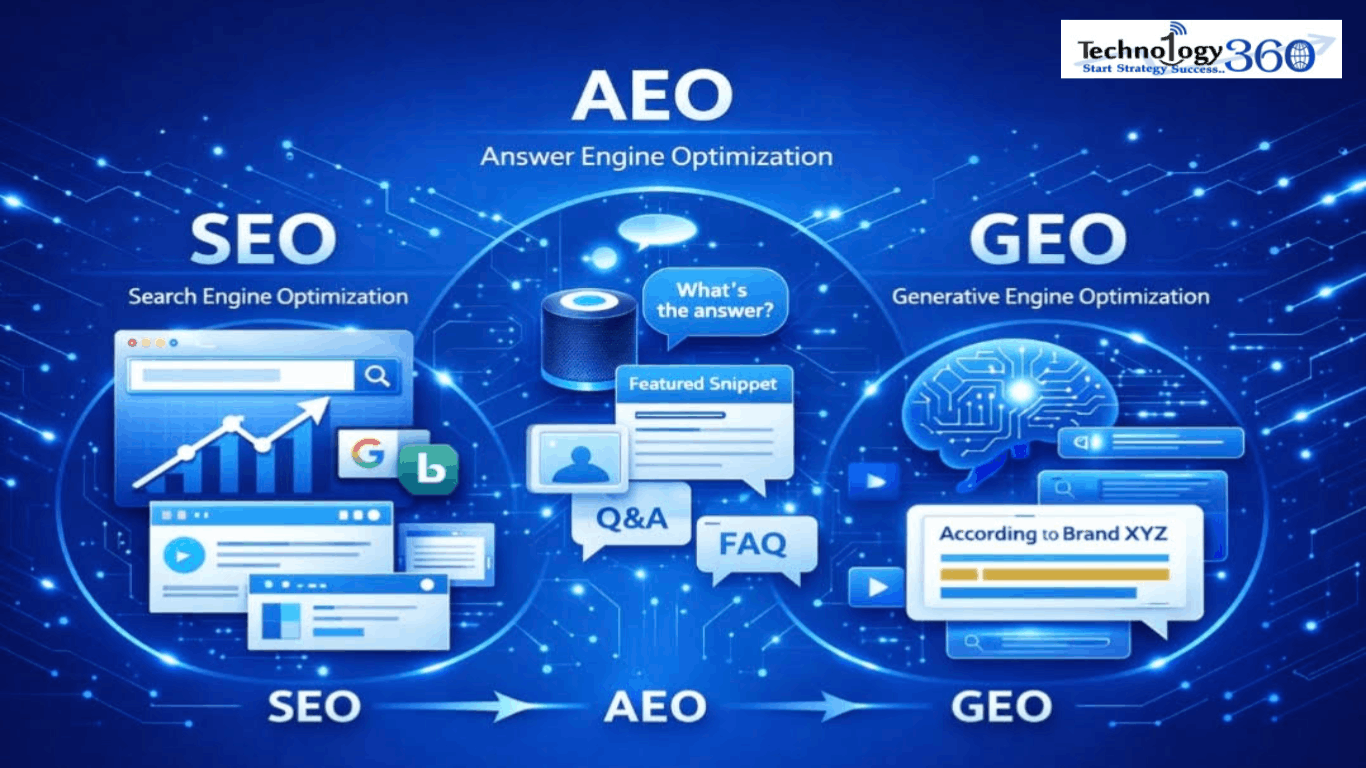
SEO – Ranking on search engines
AEO – Becoming the best direct answer
GEO – Getting cited in AI-generated responses
Using only one strategy limits your visibility. Combining all three future-proofs your digital presence.
What Is SEO (Search Engine Optimization)?
SEO is the process of optimizing your website to rank higher on search engines like Google and Bing. By optimizing the content, technical, and authority factors, SEO helps websites rank high, driving more relevant, targeted traffic and improving user experience
How SEO Works:
- SEO helps search engines:
- Crawl your website
- Index your pages
- Rank them based on relevance and quality
What are Goal of SEO
- Increase organic traffic through higher rankings
- Key SEO Ranking Factors
- Keyword research and optimization
- High-quality, original content
- Backlinks and domain authority
- Page speed and mobile friendliness
- Technical SEO (HTTPS, indexing, schema)
- User experience and engagement
SEO Example
When users search for “best digital marketing services”, SEO helps your website appear on the first page of Google.
What Is AEO (Answer Engine Optimization)?
AEO focuses on optimizing content to directly answer user questions instead of just ranking links, the process of structuring digital content to provide direct, concise answers to user queries, ensuring visibility in AI-powered search results like ChatGPT, Google Gemini, and voice assistants (Siri, Alexa). Unlike traditional SEO aimed at ranking links, AEO focuses on appearing in featured snippets.
AEO is crucial for:
- Featured snippets
- Voice search results
- “People Also Ask” sections
How AEO Works
AEO structures content in a way that search engines can easily extract short, accurate answers, making it easily consumable by AI, voice assistants (Siri, Alexa), and search engine featured snippets
Goal of AEO
- Become the single best answer shown by search engines
- Key AEO Ranking Factors
- Question-based content (who, what, how, why)
- FAQ sections
- Conversational language
- Schema markup (FAQ, How-To)
- Clear answers within 30–50 words
AEO Example
When someone asks, “What is answer engine optimization?”, AEO helps your content appear as the featured snippet or voice answer.
What Is GEO (Generative Engine Optimization)?
GEO (Generative Engine Optimization) is the newest form of search optimization. It focuses on making your content visible and citable in AI-generated answers produced by generative search engines.
How Generative Engine Optimization Works
GEO ensures your content:
- Is trusted by AI models
- Has strong context and structure
- Is referenced inside AI summaries
Goal of GEO
Get your brand mentioned or cited inside AI-generated responses
Key GEO Ranking Factors
- Strong E-E-A-T (Experience, Expertise, Authority, Trust)
- Entity-rich and factual content
- Clear content hierarchy
- Original insights and data
- Brand consistency across platforms
- Topical authority
GEO Example
When users ask AI tools “Which company offers SEO services?”, GEO helps AI mention your brand directly in the answer.
SEO vs GEO vs AEO: Key Differences Explained
| Feature | SEO | AEO | GEO |
| Primary Focus | Website rankings | Direct answers | AI-generated responses |
| Platform | Search engines | Voice & snippets | AI & generative search |
| Output | Clickable links | Instant answers | Brand mentions |
| Content Style | Keyword-focused | Q&A-based | Contextrich authority |
| Competition Level | High | Medium | Very High |
| Conversational | Search Intent | Informational & transactional | Immediate |
SEO vs AEO vs GEO: Which One Should You Use?
Use SEO If:
- You want consistent organic traffic
- You target competitive keywords
- You run blogs, service pages, or e-commerce sites
Use AEO If:
- Your audience asks many questions
- You want featured snippets and voice search visibility
- You need fast-answer visibility
Use GEO If:
- You want visibility in AI-powered search
- You want your brand cited by AI tools
- You’re planning for future search trends
Best Practice: Use SEO + AEO + GEO together
Why Generative engine optimization Is the Future of Search Optimization
Search is shifting from:
Searching links → Receiving answers
AI engines summarize information instead of listing pages. If your content is not GEO-optimized, AI may never mention your brand, even if your website ranks well.
Final Thoughts: SEO, AEO, and GEO Working Together
- SEO builds traffic and rankings
- AEO builds visibility and trust
- GEO builds authority in AI-driven search
In 2026, successful brands optimize for search engines, answer engines, and AI models simultaneously.