
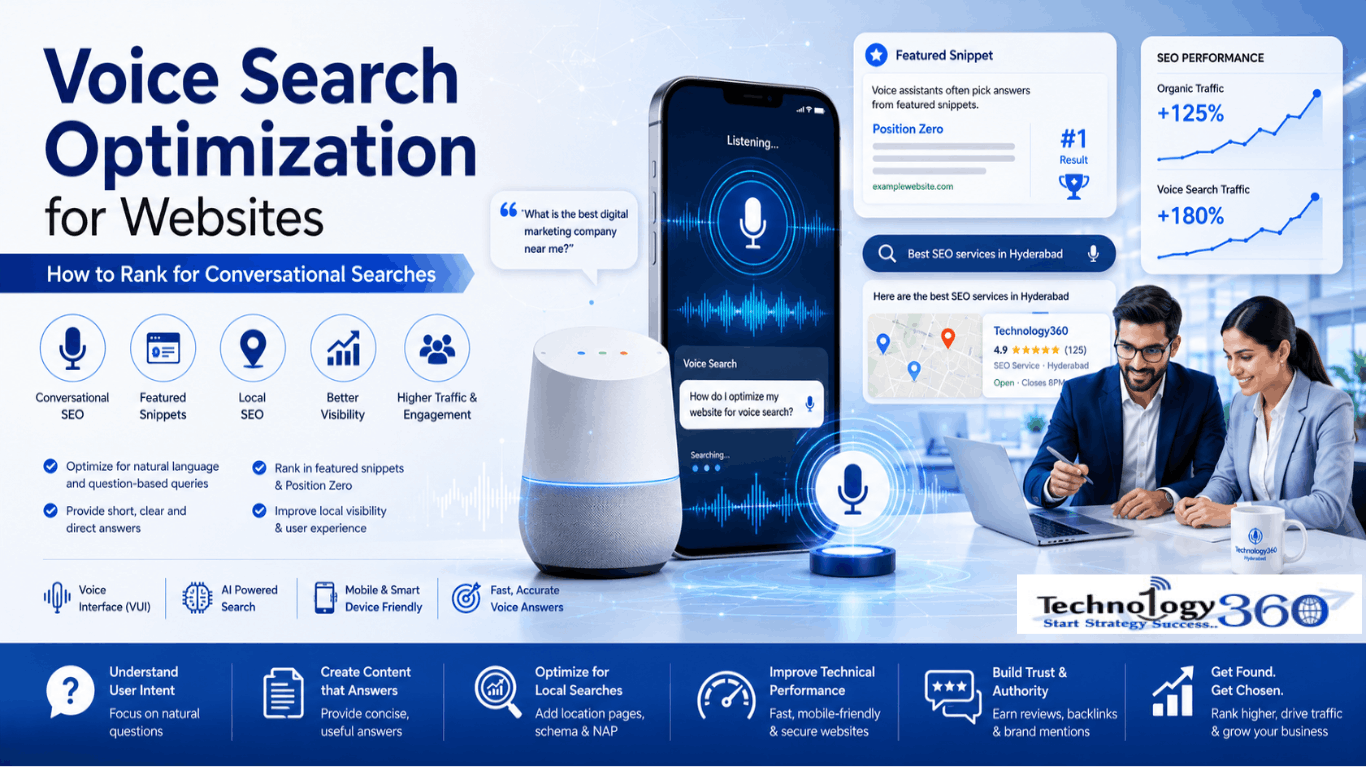
Voice Search Optimization for Websites: How to Rank for Conversational Searches
Discover how voice search optimization for websites works, what content performs best for voice queries, and how Technology360 Hyderabad helps businesses succeed with conversational SEO.
Introduction
Voice search is transforming how users interact with websites. Instead of typing keywords, people now ask complete questions like “How do I optimize my website for voice search?” This shift means businesses must adapt their SEO strategies to match how users speak, not just how they type. That’s where voice search optimization for websites becomes essential.
What Is Voice Search Optimization?
Voice search optimization focuses on structuring website content so search engines can deliver clear spoken answers. Unlike traditional SEO, it emphasizes natural language, question-based queries, and direct responses. Search engines often pull voice answers from featured snippets, FAQs, and well-structured content.
People think voice search SEO is the same as traditional SEO because voice commands are eventually converted into text. But voice search works a little differently and needs a special approach.
Beyond improving visibility, voice search SEO helps you:
- Offer a smoother and more natural user experience.
- Attract more local customers and increase foot traffic to your business.
- Make the content accessible to people with disabilities.
- Build stronger brand authority and earn user trust.
While voice search does improve customer experience, it can sometimes reduce direct visits to your website because users get answers instantly. That’s why it’s important to fine-tune your content and calls-to-action, so people who find you through voice search are encouraged to take the next step and convert.
How Voice Search Works: A Simple Explanation
Voice search feels instant, but there’s a smart process working in the background. Here’s an easy way to understand how it works:
1. Speaking your question
When you speak into a device like your phone, smart speaker, or any voice-enabled gadget.
2. Turning speech into text
The voice assistant listens and converts your spoken words into written text. It’s trained to understand different accents, speaking speeds, and ways of talking, so even if your pronunciation isn’t perfect, it usually understands you.
3. Understanding your question
Next, the system reads the text and figures out what you’re asking. Is it a question, a request, or an instruction? and it also understands whether you want information, a product, or a nearby place.
4. Matching your intent
The assistant then decides the best type of answer to give. For example, if you say, “Where can I buy affordable hiking boots near me?” it knows you’re looking for local shopping options.
5. Giving you the answer
Finally, the system will find the most relevant result and respond—often by speaking the answer out loud.
So when you ask, “How tall is Mount Everest?” the assistant may reply:
“Mount Everest is 29,032 feet tall.”
All of this happens in just a few seconds, making voice search fast, easy, and convenient—exactly why people love using it.
What Types of Content Perform Best for Voice Search?
1. Question-Based Content
FAQs and question-style headings work extremely well because most voice searches start with what, how, when, or where. Clear answers improve your chances of being selected as a voice response.
2. Short and Direct Answers
Generally, the Voice assistants prefer concise answers, typically 40–60 words. Placing the answer at the top of the page, followed by supporting details, improves visibility.
3. Conversational Content
Content written in a natural, but human tone performs better than keyword-heavy text. This approach strengthens your conversational SEO strategy and improves user engagement.
4. Local Content
Many voice searches are location-based, such as “best digital marketing company near me.” Optimizing local pages and service content helps attract high-intent users.
5. How-To Content
Educational and how-to articles are ideal voice search content because users often ask for guidance using voice commands.
Role of Voice User Interface (VUI)
Modern websites are integrating voice user interface (VUI) design, allowing users to search or navigate using voice. Combined with voice search SEO best practices, VUI improves accessibility and overall user experience.
Why Voice Search Is Important for Your SEO Strategy
The Voice search is becoming more popular every day. People are busy, multitasking, and looking for quick solutions, and voice search makes life easier. Instead of typing, they will ask and get instant answers. That’s why voice search should be an important part of any modern SEO strategy.
Voice SEO isn’t just about showing up in search results. It’s about being found in the same way people actually search in real life—by asking natural questions and expecting fast, clear answers.
Here’s why voice search really matters:
1. It changes how people find information
With voice search, users don’t scroll through pages or compare multiple links. They usually get just one answer, and that answer comes immediately.
For example, if someone asks while driving,
“Where is the nearest book shop?”
Google doesn’t show ten websites. It gives one or two results at most. If your content is clear, helpful, and optimized for local searches, you have a better chance of being the chosen answer.
2. It supports zero-click searches and AI answers
Voice search works closely with zero-click results, where users will get answers without visiting a website.
For example:
“How many apples are on the tables?”
The assistant answers right away—no clicks needed. Today, AI-powered summaries work the same way.
The Content that is well-structured, straight to the point, simple, and is more likely to be picked up by voice assistants and AI tools.
3. Voice assistants prefer featured snippets (Position Zero)
Voice search results usually come from “Position Zero,” also known as featured snippets.
Final takeaway
The Voice search has been changing the way people search, how answers are delivered, and how businesses are discovered. By optimizing your content for voice—using clear language, direct answers, and local relevance—you make it easier for both users and search engines to choose you.
How Technology360 Hyderabad Supports Voice Search SEO
Technology360, based in Hyderabad, helps businesses implement effective voice search and conversational SEO strategies. From conversational keyword research to FAQ optimization and local voice SEO, Technology360 ensures websites are ready for the future of search.
Conclusion
Voice search optimization is no longer optional. By creating conversational, question-focused, and locally optimized content, businesses can stay visible and competitive. Websites that speak the user’s language will lead the next generation of search results.